
With viewing port design, for more precise connections.
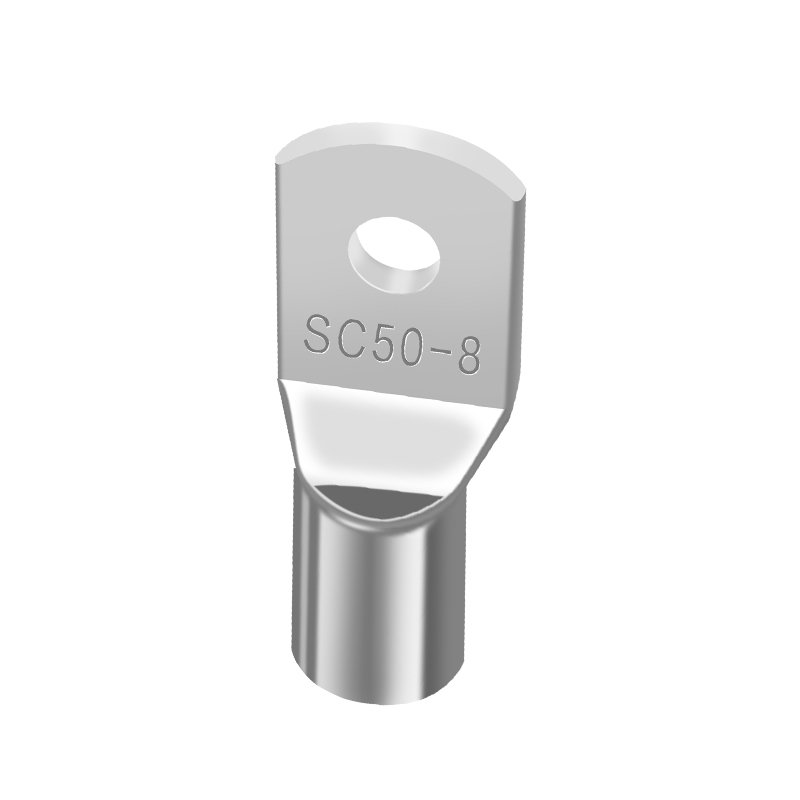
SC Copper Lug is integrally forged from T2 red copper with a purity of ≥99.9%, featuring conductivity ≥58 MS/m. It meets the current-carrying requirements of cables of various specifications, with no overheating risks during high-current transmission.
The core viewing port design enables precise alignment with cable conductors, avoiding crimping deviation, maximizing contact area and minimizing contact resistance.
The surface is tin‑plated (thickness 0.5–0.8 mm), passing a 48‑hour salt spray test without corrosion, effectively isolating air oxidation and extending service life.
With tensile strength ≥180 MPa, it fits tightly to the conductor without loosening after crimping and operates stably in a wide temperature range from -30℃ to 60℃.
It complies with the national standard GB/T14315-2008, balancing versatility and reliability.
Available in a full range of specifications from 1.5 mm² to 300 mm², it fits both solid and stranded copper conductors, meeting most electrical connection requirements without non‑standard customization.
The installation process is simple: quick positioning via the viewing port requires no professional calibration tools, and crimping can be completed with an ordinary crimping tool for convenient and time‑saving operation.
The standardized bolt hole design fits various terminals and equipment studs, providing firm fixation.
For copper‑aluminum connections, a transition connector is required to avoid electrochemical corrosion. Regular inspection and maintenance are easy, making it suitable for on‑site construction and batch installation.
Universal for all scenarios, laying a solid connection foundation!
Used in building electrical wiring, the viewing port ensures precise positioning for residential and commercial cable connections.
Used in industrial equipment, it withstands normal load conditions with tight, secure crimping.
Used in distribution boxes and cabinets, it fits standardized terminals for neater and safer wiring.
Used in communication equipment terminals, it ensures stable signal transmission and meets precision wiring needs.
Used in civil engineering circuits, it features strong versatility and easy installation, making it an essential basic component in the field of electrical connections.
